By Betty Luke
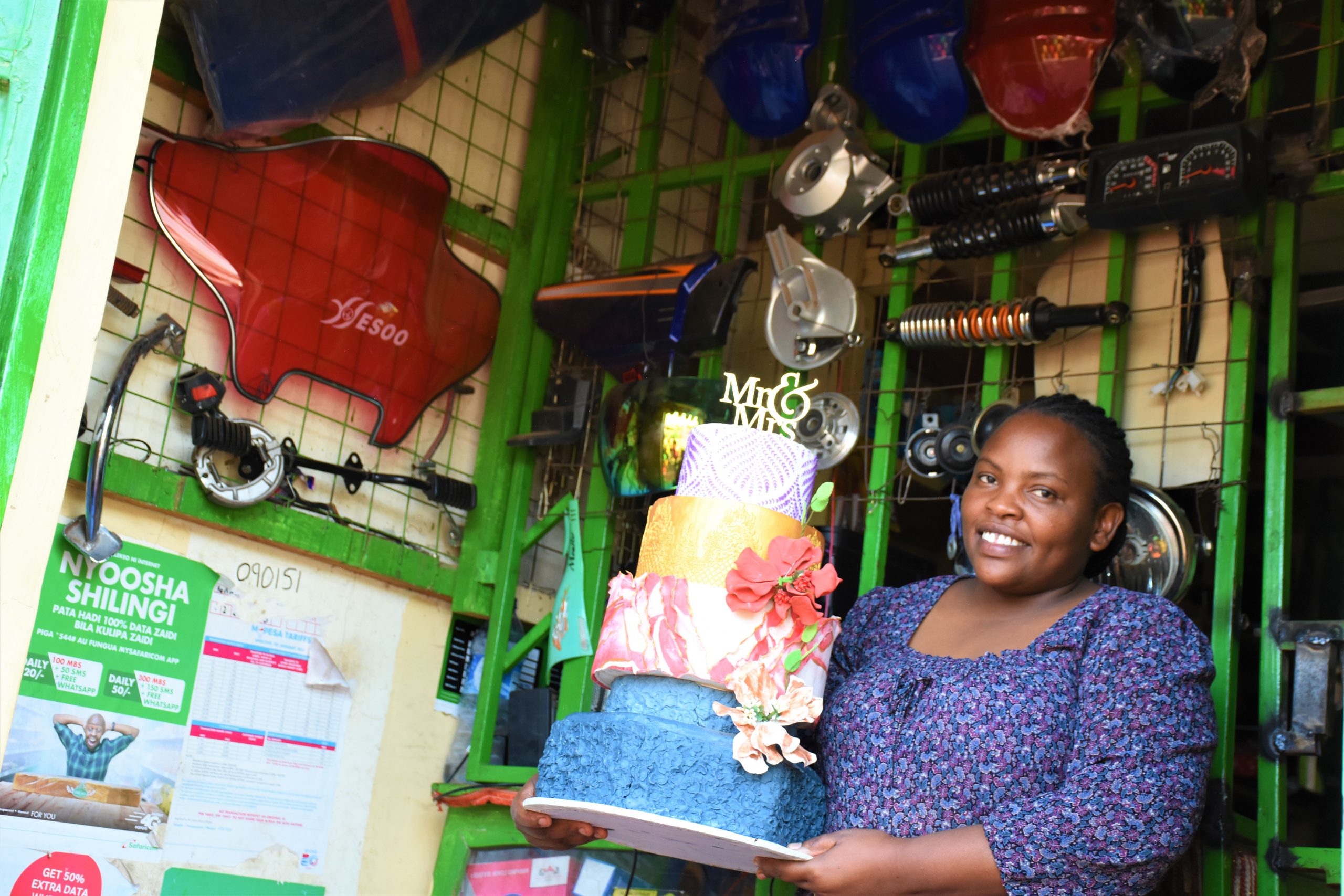
Pauline Waithira Njuguna, 31, was operating a motorbike spare parts shop before Coronavirus struck the country in March 2020, and the government instituted a nationwide dusk to dawn curfew.
A month later, the government declared a cessation of movement in and out of Nairobi, Mombasa, Kilifi and Kwale counties sinking several businesses into recession which in turn rendered countless Kenyans jobless.
Established in the Northern part of the country where the main means of transport especially in towns is motorbikes, her business was booming that she had to employ four other people including two mechanics to help in selling the spare parts as well as repairing motorbikes.
Located at Mukuu area, Isiolo along the Isiolo-Moyale highway, the business lady would make a profit of up to Sh10, 000 on a good day and Sh7, 000 on a seemingly bad day enough to fully provide for her family of four.
Unknown to the mother of three, her business, like others across the country, would deteriorate after the State instituted a partial lockdown and a nationwide curfew to stem further spread weeks after reporting the first case.
Her clients drastically reduced as movements of people and transportation of goods remained limited, while prices of commodities started skyrocketing.
“I was and I am still her customer because she sells legitimate and quality items at fair prices compared to other dealers within Isiolo town,” said Mr Joseph Nderitu, a boda rider.
Ms Waithira’s efforts to revive the dwindling business failed terribly forcing her to close down the then three-year-old business dealing a huge blow to her source of income.
“I had to use all the savings I had as because I was no longer making profit. I would sell items at the same price I had bought them to at least get money for food,” said Ms Waithira in a recent interview.
Unaware, some baking skills she had learnt from a friend few weeks earlier would offer her a lifeline at a time when she was almost sinking into depression due to loss of her livelihood.
Thousands of Kenyans lost their jobs following the hard economic times occasioned by the pandemic.
Three days after closing down the business, Ms Waithira took a bold step and bought an oven with money borrowed from a friend as she had exhausted her savings and immediately started putting her skills into practice as she contemplated on her next move.
“I only managed to purchase an oven with the borrowed cash. I then borrowed two sufuria’s from my neighbor since mine were very small and I had no baking tins,” she recalls.
She says she started baking for her family consumption before later giving out free samples to neighbours who later embraced her cakes and became her customers and even referred their friends to her shop.
Baking starts with blending eggs with butter and sugar until you obtain a smooth paste that is then mixed with wheat flour.
The mixture is then put in a tin and placed in an oven, heated for approximately 25-30 minutes under 180 degree Celsius which is subject to change depending with the baker’s preference.
However, lower temperatures and more time prevents the cake from burning according to Ms Njuguna.
She remembers her first commercial cake that she says took a whole day as she had to ensure it was perfectly done so as to retain the customer.
“Out of excitement, I had to redo the cake severally to ensure the customer was satisfied as that would see her refer friends to me. I sold it at Ksh 1000 only as I was not interested in making profit but in popularizing my product,” she narrates.
Her cakes ranges between Sh1,800 to Sh8,000 depending on quantity and design.
A basket model, for example, would cost more than a normal circular cake as it requires more time and ingredients.
Three months after baking her first commercial cake, Ms Waithira was able to pay back the money she had borrowed from a friend as well buying several baking tins in her bid to fully satisfy the growing demand for cakes.
Baking, she says, requires patience, creativity and willingness to learn new designs in order to attract wide range of clients.
“It is very embarrassing when a customer comes and I tell them I don’t know how to make the design they want. Such customer can never come back again,” Ms Waithira says adding that online materials have also been very helpful in masterly of the skill.
She sells at least 25 cakes every month earning about Sh45, 000 with part of it going to savings.
While starting the business, she says majority of her customers were from referrals but many of her current customers reach her out via social media pages.
Networking with established and renowned bakers has also assisted her learn new cake designs that gives her an edge over other bakers in Isiolo and neighbouring counties.
“Apart from the primary lessons I got before starting, I have also attended tens of others including those organized by other bakers online,” she adds.
Acquiring ingredients locally was her biggest challenge until the government fully lifted a ban on movement in and out of the country’s capital.
When the government lifted the nationwide curfew on October 20 last year, it was a sign of hope for the entrepreneur as she would have her cake shop open for a longer period.
What started as a hobby has not only helped revive her business but also given birth to her Peclet Bakers shop that major in birthday, corporate and traditional cakes and sells to as far as Samburu, Marsabit, Meru, Nyeri, Laikipia and Nairobi counties.
Ms Waithira has appealed to other women to seize available opportunities and cease from overreliance on a single source of income as in most cases turn out to be unreliable.
“I never imagined I would ever thrive in business but it turned out to be my main source of income,” says the entrepreneur who now earns an average of Sh70, 000 from the business monthly.
Her long term plans includes opening branches in other Northern Kenya counties as well as starting baking classes.
This publication was produced with the financial support of the European Union. Its contents are the sole responsibility of Betty Luke and do not necessarily reflect the views of the European Union