By Betty Luke
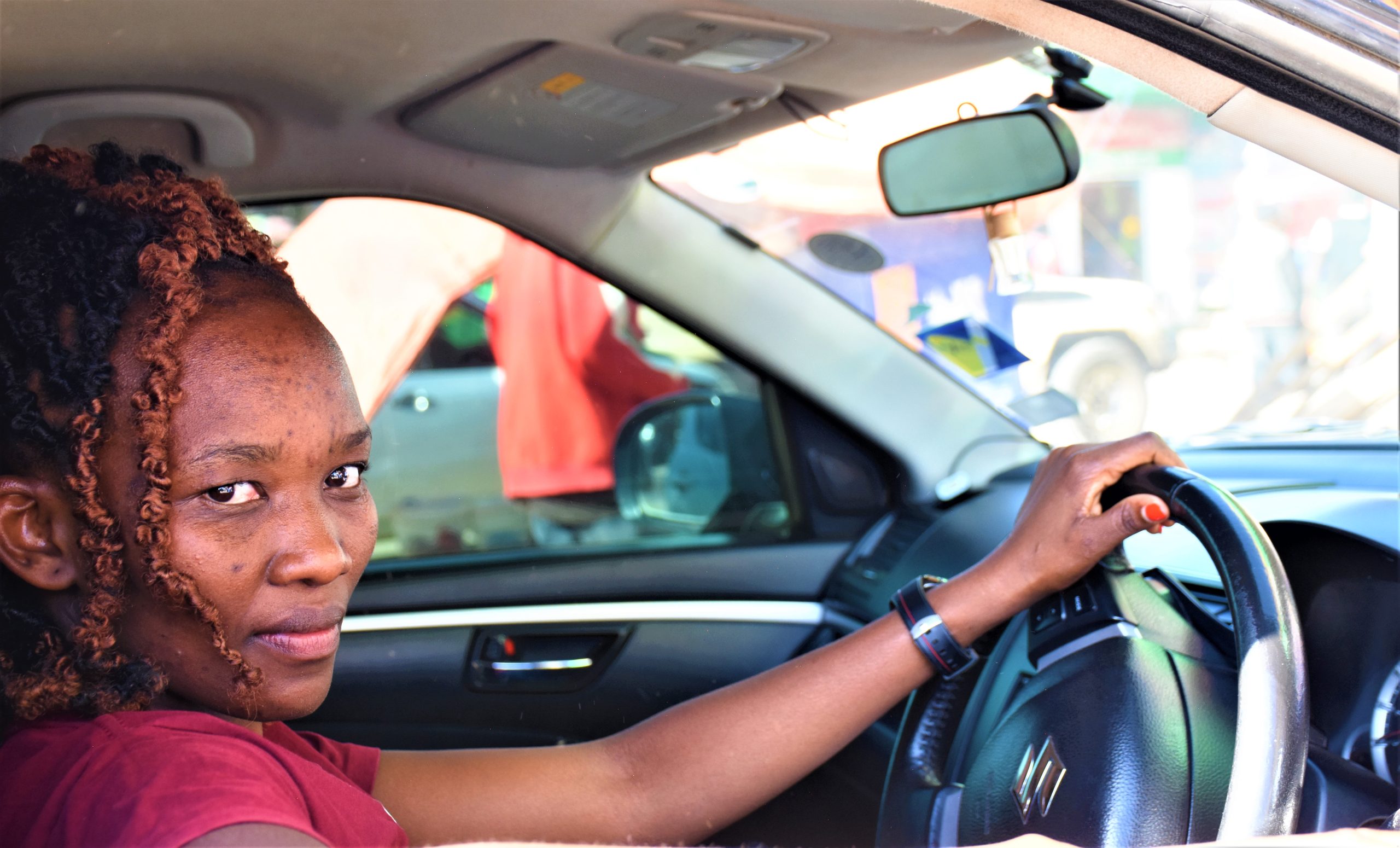
Faith Kinanu, 28, used to sell seedless oranges from Ukambani but not until Covid-19 pandemic struck the country in March 2020.
The movement restrictions introduced by the government to stem spread of the disease dealt a big blow to her then booming business throwing her back to the drawing board.
“I could no longer travel to Makueni (due to the restrictions) and had to look for an alternative source of income,” she says.
Having earlier done a driving course, the idea of venturing into taxi business sounded the most realistic to her even though she had no vehicle to start off.
Unknown to her, she would join the list of most popular taxi drivers in Isiolo County and thrive in the male-dominated transport business.
She was forced to hire a friend’s car with hopes high she would be able to pay the daily costs and make profit enough to sustain her basic needs.
Taxi not for women
Working in a patriarchal society, taxi business was however not a walk in the park for the lady who majority of the male clients initially insisted should have ventured into a less demanding job and perhaps, parenting.
“The few who approached me would make fun saying I should engage in business that ‘suit’ women or remain at home to take care of my husband and children,” she said during a recent interview with The Press Point.
Business made a downturn during the first months and on several occasions, Ms Kinanu went for days without a single customer as majority of them (due to the stereotypic fixations) preferred services of her male colleagues.
Her resilience amid ridicule and discouragements from a section of her customers and her male colleagues would later prove old adage that persistence pays.
Ms Kinanu is the only female taxi driver in the county’s most populated and fast growing Isiolo town which she says, gives her an edge over her male colleagues.
She makes a profit of between Sh2000 to Sh3000 daily but quickly says business is yet to revert back to normal, challenges she attributes to the high cost of fuel.
“Some of the days I go home with no single coin but I remain optimistic that the following day would be better,” she notes.
Sexual advancements
For safety reasons, she works until 6PM and occasionally serves clients well known to her and who she can trust past the working time.
The driver has on several occasions turned down sexual advancement offers by male customers.
“A client will ask me to take them somewhere but on arriving at the destination, they make sexual advances which I decline. I have taught myself to maintain a high level of discipline and professionalism to survive in the industry,” Ms Kinanu reveals.
Asked how she deals with rogue motorists especially boda riders in the busy Isiolo town, Ms Kinanu says her weapon was remaining mum and doing what is right as responding to them would attract scorns.
“They overtake while on the wrong side and sometimes even stop to harass me while I am on the right lane. I just ignore and proceed with my business,” she says.
She has on many occasions been bullied making her contemplate quitting but support from some of her colleagues and her family has been her source of encouragement.
“I am keen on offering quality and satisfactory services to my clients and their feedback so that I improve on my weak areas and ensure they are more comfortable the next time I serve them,” she concludes.
Women participation low
A recent research by the Kenya Institute of Public Policy Research and Analysis revealed that women’s economic participation even in sectors rarely monitored by the government was still low.
Mr Naphtaly Kimathi says he prefers female taxi drivers compared to their male counterparts while on his daily work errands in or out of the county.
According to him, women are more keen drivers than men and that quite a number of the latter group engage in other activities while driving.
“I prefer her (Ms Kinanu) because I have never encountered any challenge with her. She is keen on the road and drives according to customer’s instructions,” says Mr Kimathi.
According to the World Health Organization (WHO), employment was reduced by 21 percent at the start of the pandemic following the Covid-19 related restrictions.